How high can a private parking penalty be in Germany?
How high may a contractual penalty (Vertragsstrafe) for unauthorised parking on private ground be in Germany? Learn what makes an amount reasonable, which costs cannot be recovered and how to enforce your claim on a sound legal footing.

 Parking Law & Practice3 min read


Overview.
How high may a contractual penalty (Vertragsstrafe) for unauthorised parking on private ground be in Germany? Learn what makes an amount reasonable, which costs cannot be recovered and how to enforce your claim on a sound legal footing.
Table of contents
Vehicles parked without authorisation on private car parks or company premises are a familiar nuisance for owners, landlords and businesses. A contractual penalty is one way to tackle the problem. But how high may this amount actually be — and where is the line between a justified claim and overreach?
Legal situation: not a fine, but a contractual claim
Unlike a fine on public roads, the contractual penalty is based not on public law but on civil law. Anyone who parks on a suitably signposted private car park enters into a usage contract (BGH, judgment of 18.12.2019 – XII ZR 13/19). The contractual penalty for breaches is part of those conditions (§§ 339 ff. BGB).
What matters for the amount: the conditions of use are standard business terms (AGB, §§ 305 ff. BGB). They are therefore subject to a fairness review — disproportionately high amounts can be invalid under § 307 BGB.
How high may a contractual penalty be?
There is no statutory amount. The key requirement is that the penalty is reasonable, and that has to be assessed case by case. Case law does offer one reference point: the case decided by the BGH in 2019 concerned an increased parking fee of €30.
Asking for considerably more risks the clause being judged unreasonable and the claim failing altogether.
What cannot be claimed on top of the penalty
Alongside the contractual penalty, damages claims may come into play — but not just any:
- Towing costs: if the vehicle is towed, the person responsible must bear the costs as damages (BGH, judgment of 05.06.2009 – V ZR 144/08), but only at the customary local rate.
- Parking enforcement: the costs of general parking enforcement cannot be recovered (BGH, judgment of 04.07.2014 – V ZR 229/13). They cannot simply be passed on to individual illegal parkers.
How to make your claim legally sound
Signage. A clearly visible sign at the entrance setting out the conditions of use and the amount of the penalty is a precondition for the conditions to take effect at all. Suitable signs are available under parking signs.
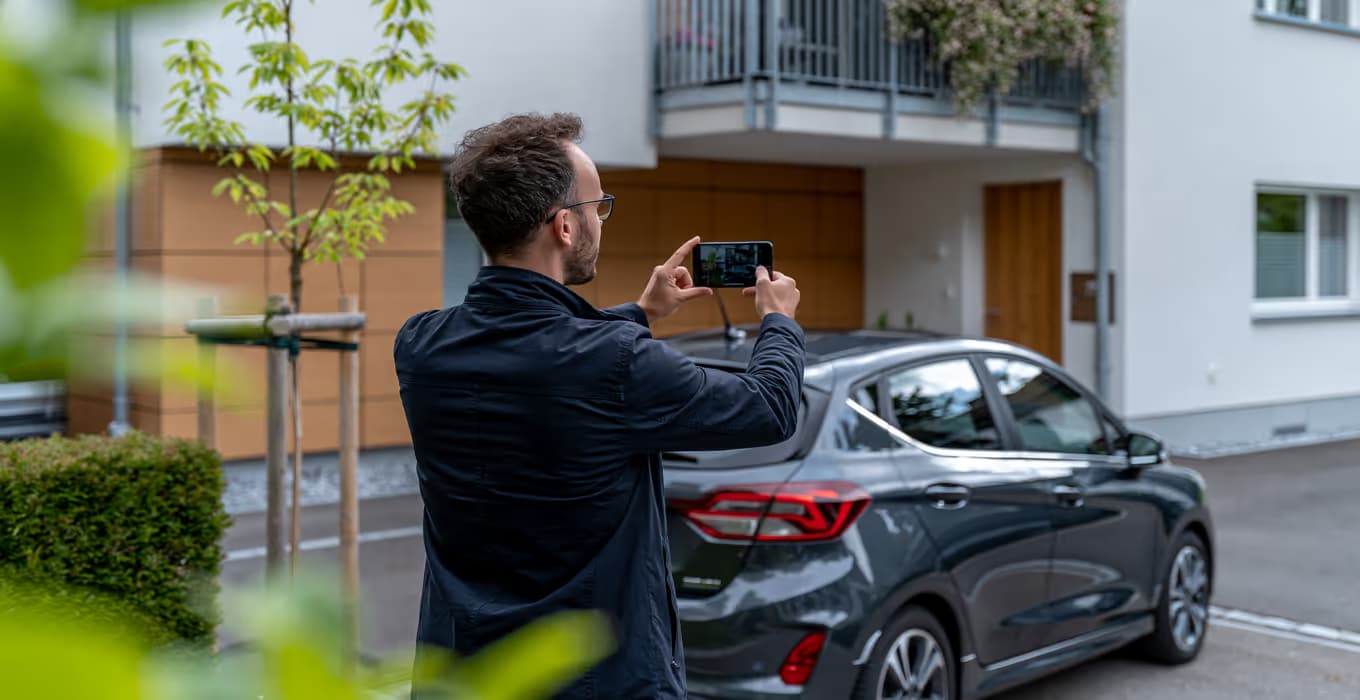
Complete documentation. Photos of the vehicle, the number plate and the sign, plus a precise timestamp, are essential. Where you have a legitimate interest, you can identify the keeper by requesting keeper information from the Federal Motor Transport Authority (Kraftfahrt-Bundesamt, § 39 StVG).
Stay reasonable. Stick to a moderate amount. An excessive claim weakens your position — even when the violation is clear-cut.
Enforcement in practice
Many owners and possessors shy away from the effort or from direct conflict with the illegal parker. Specialised providers such as FalschParker.io step in here: with FalschParker you scan the number plate, take a photo and confirm the location. FalschParker then handles the contractual penalty process and collection; you assign the claim digitally by signing an assignment declaration in the app. Find out more under contractual penalty.
Conclusion: a fair amount with a sense of proportion
The contractual penalty is a legitimate tool against unauthorised parking — but only as long as it remains reasonable. There is no fixed upper limit; in the case decided by the BGH the amount was €30. Clear signage, clean documentation and a moderate amount are the best foundation for a claim that holds up. That way the contractual penalty remains what it should be: a fair consequence, not an inflated ticket.
This article is general information and not legal advice.
Protect your parking spot today.
FalschParker helps property owners and tenants enforce private parking rules — without paperwork.
Download app