Contractual penalties on private car parks: what signage is required?
Learn which signage and which conditions you need as a parking-space owner in Germany so that you can validly claim a contractual penalty (Vertragsstrafe) from illegal parkers.

 Parking Law & Practice4 min read

Overview.
Learn which signage and which conditions you need as a parking-space owner in Germany so that you can validly claim a contractual penalty (Vertragsstrafe) from illegal parkers.
Table of contents
Unauthorised parking on private parking spaces is an everyday nuisance — especially for owners, tenants, property managers and parking operators. It also means effort: securing evidence, identifying the keeper, drafting letters. Many ask themselves:
What do I need to do so that I can validly claim a contractual penalty from illegal parkers?
The short answer: the right signage is decisive. Here is what applies and how to proceed.
What is a contractual penalty on a private car park?
Parking a vehicle on a suitably signposted private car park creates a usage contract (BGH, judgment of 18.12.2019 – XII ZR 13/19). The contractual penalty (Vertragsstrafe, §§ 339 ff. BGB) is part of those conditions of use and becomes due when someone breaches them — for example by parking without authorisation.
Unauthorised parking is also unlawful interference with possession (verbotene Eigenmacht, § 858 BGB), against which the possessor may in principle use self-help (§ 859 BGB), such as towing.
Why is signage so important?
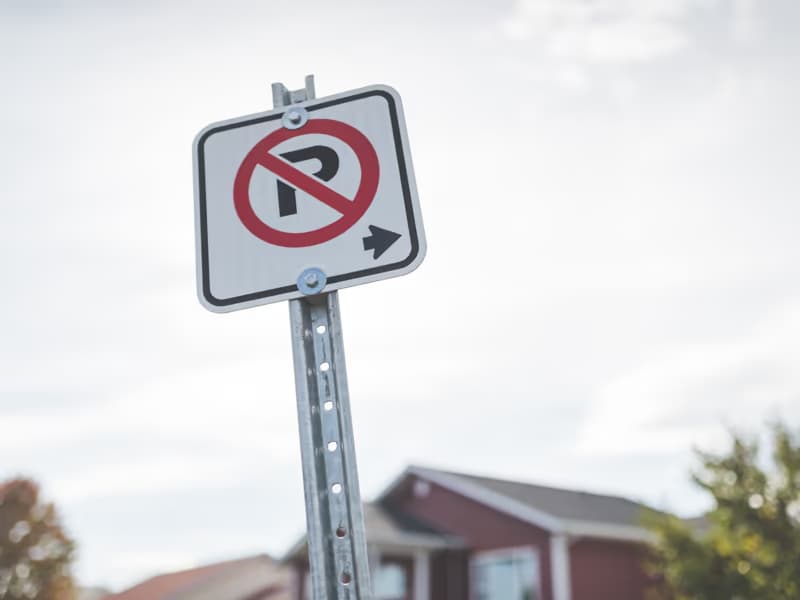
Germany has no court-ordered parking ban that you would need to apply for in advance. What counts instead is the signage: the conditions of use are standard business terms (AGB, §§ 305 ff. BGB). They only become effective if they are clearly pointed out before parking — in practice through a clearly visible sign at the entrance. Without it, enforcement becomes difficult.
How can parking-space owners proceed?
- Put up signage
- A clearly visible sign right at the entrance, noticeable before parking
- A clear statement that it is a private car park and who may park there
- The conditions of use, including the amount of the penalty, in a legible form
- Suitable signs are available under parking signs
- Secure evidence
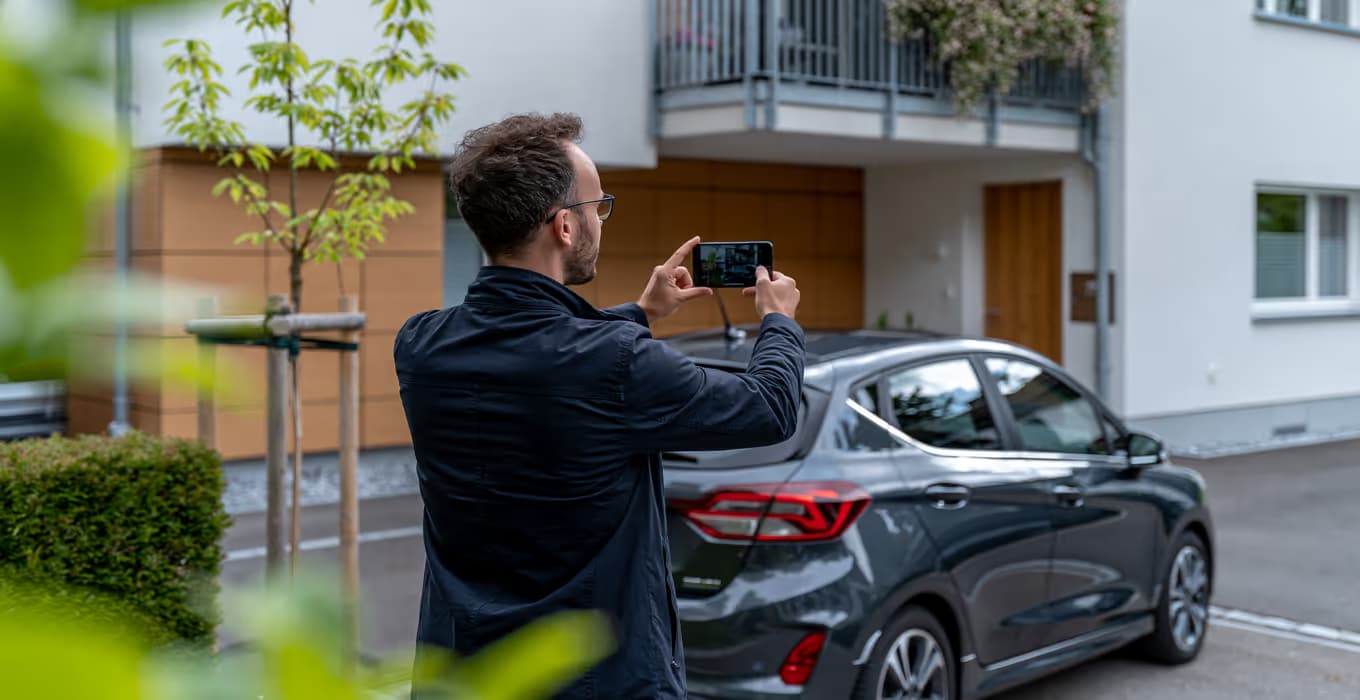
- Photos of the vehicle with a clearly legible number plate, including date and time
- A photo of the sign at the entrance to prove the signage
- Identify the vehicle keeper
- Request keeper information from the Federal Motor Transport Authority (Kraftfahrt-Bundesamt, Central Vehicle Register)
Keeper information can be obtained where there is a legitimate interest in enforcing legal claims (§ 39 StVG). Photos and number plates may be processed on the basis of legitimate interest (Art. 6(1)(f) GDPR) — but only for that purpose and no longer than necessary.
- Claim the contractual penalty
- A clear letter citing the conditions of use and the breach
- Payment deadline, contact details and a note on legal steps if unpaid
Tip: with FalschParker.io, parking-space owners handle these steps digitally — in FalschParker you scan the number plate, take a photo and confirm the location. FalschParker then handles the contractual penalty process and collection. Free QR-code notices can be ordered via support@falschparker.io.
How high may the contractual penalty be?
There is no statutory flat rate. The amount must be reasonable; disproportionately high amounts can be invalid (§ 307 BGB). The case decided by the BGH concerned an increased parking fee of €30. More on this in How high can a private parking penalty be in Germany?
What to do in case of non-payment?
- Send a reminder: polite but firm, with a deadline
- Ask for the driver to be named: if the keeper denies having driven, they must state who could have been the driver — otherwise they are liable themselves
- Assign the claim: you can assign the claim to a service provider (§§ 398 ff. BGB), which then enforces it
Here too, FalschParker.io supports you: you sign the assignment declaration digitally in the app.
Common misconceptions
❌ "I can claim any penalty even without a sign." False. Without a clear notice before parking, the conditions do not take effect.
❌ "It's an illegal ticket." False. It isn't a fine but a civil-law, contractual claim.
❌ "Only the Ordnungsamt may intervene." False. The public order office is responsible for public roads. On private ground, enforcement is in principle a matter for the entitled party.
Conclusion
Illegal parking on private spaces is not just annoying — it causes real effort. Parking-space owners in Germany can defend themselves without any official procedure — the key requirement is clearly visible signage at the entrance.
With clear signage, clean documentation, a reasonable amount and a structured approach, uninvited parkers can be held to account.
This article is general information and not legal advice.
Protect your parking spot today.
FalschParker helps property owners and tenants enforce private parking rules — without paperwork.
Download app